
Best Blinds for Calgary’s Climate: A 2026 Homeowner’s Guide
Quick answer: For Calgary homes, cellular (honeycomb) shades and dual roller blinds offer the best year-round performance. They handle our extreme temperature swings — from -30°C cold snaps to chinook-driven 20°C swings in a single day — by insulating against heat loss in winter and blocking solar gain in summer. For south- and west-facing windows, add solar or sunscreen shades to protect floors and furniture from intense Alberta UV.
If you want the short version, that’s it. The rest of this guide explains why, what to put in each room, what it costs in Calgary in 2026, and how to avoid the three mistakes we see most often.
Why Calgary windows need different blinds than the rest of Canada
Calgary’s climate is genuinely unusual. We have:
- The widest temperature swings of any major Canadian city — chinooks can lift temperatures 20–30°C in hours
- More than 330 days of sunshine per year — among the highest in Canada
- High-altitude UV exposure at 1,045 m above sea level, which fades flooring, furniture, and artwork faster than at lower elevations
- Long heating seasons that punish poorly insulated windows on your utility bill
A roller blind that works fine in Vancouver or Toronto can underperform here because it’s solving the wrong problem. In Calgary, your blinds need to manage heat loss, solar gain, and UV — often on the same window, in the same week.
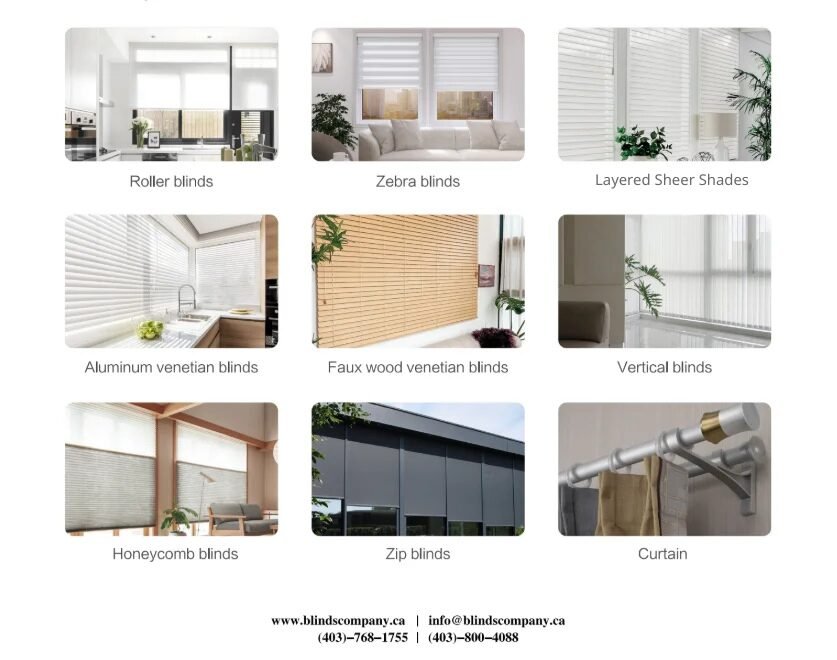
The four blind types that perform best in Calgary
1. Cellular (honeycomb) shades — best for insulation
Cellular shades have hollow pockets that trap air, giving them the highest R-value of any common window covering. Independent testing has shown well-fitted cellular shades can reduce heat loss through windows by roughly 40%, which matters when you’re heating a home through five-month winters.
Best for: Bedrooms, north-facing windows, basement windows, anywhere you feel a draft in January. Avoid for: High-humidity rooms (some fabrics absorb moisture) and very large windows where the cell structure becomes visually heavy.
2. Dual roller blinds — best all-rounder
Dual rollers combine a sheer/light-filtering shade with a blackout or room-darkening shade on the same bracket. You get full daylight, full privacy, or full blackout from one window — a serious advantage in a city where the sun rises before 5 a.m. in June and sets at 4:30 p.m. in December.
Best for: Living rooms, primary bedrooms, home offices. Avoid for: Tight reveals where the doubled headrail won’t fit.
3. Zebra blinds — best for daytime light control
Zebra blinds (also called day-night or transitional shades) alternate solid and sheer horizontal bands. Slide them slightly to filter light, or align the solid bands for privacy. They look clean and modern, and they handle Calgary’s bright winter glare well without the bulk of curtains.
Best for: Kitchens, dining rooms, modern living spaces, condos. Avoid for: Bedrooms where you need true blackout.
4. Solar / sunscreen shades — best for UV protection
Solar shades are woven from a technical fabric rated by “openness factor” — typically 3%, 5%, or 10%. A 3% shade blocks roughly 97% of UV and significantly reduces solar heat gain while preserving the view out. This is the right product for west-facing windows in Calgary, where afternoon sun in summer is brutal on hardwood and upholstery.
Best for: South- and west-facing windows, rooms with valuable flooring or artwork, large picture windows. Avoid for: Bedrooms (they’re not blackout) and any window where privacy after dark is a priority — a lit room behind a solar shade is visible from outside.
Room-by-room recommendations for Calgary homes
| Room | First choice | Second choice | Why |
| Primary bedroom | Blackout cellular shades | Dual roller with blackout layer | True darkness during long June daylight; warm in winter |
| Living room | Dual roller blinds | Zebra blinds | Flexibility for daytime light + evening privacy |
| Kitchen | Zebra blinds | Faux wood blinds | Easy to clean, handle humidity and grease better than fabric |
| Bathroom | Faux wood or PVC blinds | Cellular with moisture-resistant fabric | Real wood warps in humid environments |
| Home office | Solar shades (5% openness) | Dual roller | Reduces screen glare without losing daylight |
| Basement | Cellular shades | Roller with blackout | Insulation matters most where you feel cold |
| West-facing rooms | Solar shades (3% openness) | Motorized roller with timer | UV and heat-gain control is the priority |
How much do custom blinds cost in Calgary in 2026?
Honest pricing ranges, based on average residential windows (roughly 36″ × 60″):
- Basic roller blinds: $90–$180 per window
- Zebra blinds: $150–$280 per window
- Cellular / honeycomb shades: $180–$400 per window
- Dual roller blinds: $220–$420 per window
- Solar shades: $160–$320 per window
- Motorized upgrade: add $150–$300 per window
- Professional installation: typically $25–$60 per blind, often discounted or included with full-home orders
A typical Calgary home with 12–15 windows usually lands between $2,500 and $6,000 for a full custom installation, depending on fabric tier, motorization, and blackout requirements. Bay windows, oversized openings, and angled tops add cost.
These ranges are for custom-fit blinds from a local installer. Big-box pre-cut blinds are cheaper up front but rarely fit Calgary’s older homes well — particularly in the inner city, where window openings are often out of square.
The three mistakes Calgary homeowners make most often
- Choosing blinds based only on summer. Calgary blinds need to perform in February as much as in July. If you only think about glare and heat, you’ll end up with thin shades that let cold radiate off the glass in winter. Always ask about R-value or insulation rating before committing.
- Forgetting about chinooks. Rapid temperature swings cause window glass to expand and contract. Inside-mount blinds with tight tolerances can bind or rub when this happens. A good installer leaves the right clearance — usually 1/8″ to 1/4″ — which a DIY measurement often doesn’t account for.
- Underestimating UV. Calgary’s elevation and clear skies mean UV exposure is higher than most homeowners expect. South- and west-facing hardwood floors can show visible fading within two or three years behind decorative-only blinds. If you have hardwood, real wood furniture, or art on a sunny wall, treat UV protection as non-negotiable.
Should you go motorized?
Motorized blinds used to be a luxury upgrade. In 2026, they’re mainstream — and in Calgary specifically, they earn their keep:
- Automated schedules can close west-facing blinds at 3 p.m. in summer to pre-empt heat gain, then re-open them for evening views
- Smart home integration (Alexa, Google Home, Apple HomeKit) lets you adjust blinds without getting up — useful for hard-to-reach windows on vaulted ceilings, which are common in Calgary’s newer suburbs
- Battery-powered motors mean no wiring, no electrician, and continued operation in a power outage
- Child and pet safety — no cords is now the standard recommendation from Health Canada
The upgrade typically adds $150–$300 per window. For households with more than 10 windows or any window above standard reach, it usually pays back in convenience within the first year.
How to measure for blinds (and when to let a pro do it)
For a quick estimate, measure your window opening:
- Width — measure inside the frame at the top, middle, and bottom. Use the narrowest measurement.
- Height — measure from the top of the opening to the sill at the left, middle, and right. Use the longest measurement for inside mount.
- Depth — measure how deep the window recess is. Different blind types need different minimum depths (zebra blinds typically need at least 2.5″ for a flush inside mount).
For final orders, we strongly recommend a professional measure. In Calgary specifically, we see out-of-square openings on roughly one in three homes built before 1990 — and “1/8 of an inch off” is the difference between a clean fit and a blind that has to be remade.
Frequently asked questions
Are blinds or curtains better for Calgary winters? Cellular shades outperform most standard curtains for insulation, but layered window treatments — blinds plus heavy drapery — give the best winter performance. If you’re choosing one or the other, cellular shades are the better single-product investment.
Do motorized blinds work during a power outage? Battery-powered motorized blinds continue to function normally. Hardwired models do not, unless connected to a backup power source.
How long should custom blinds last? Quality custom blinds typically last 10–15 years in residential use. Mechanisms (clutches, motors, cords) wear out before fabrics do in most cases.
What’s the lead time for custom blinds in Calgary? Most custom orders take 2–4 weeks from measurement to installation. Motorized and specialty fabrics can take 4–6 weeks.
Do blinds reduce noise from outside? Cellular shades provide modest sound dampening — useful near busy roads like Crowchild Trail or Deerfoot, but they’re not a substitute for upgraded windows if noise is your main concern.
Are blinds tax-deductible or eligible for energy rebates? As of 2026, custom blinds are not directly eligible for federal Greener Homes rebates, but they may qualify under provincial energy-efficiency programs if installed alongside other upgrades. Check current Alberta program details before purchasing.
Ready to choose the right blinds for your Calgary home?
Calgary Blinds Company has been installing custom window coverings across Calgary and surrounding areas for years. We offer free in-home consultations, professional measurement, and installation by our own team — not subcontractors.
Showroom: 12180 44 St SE, Unit 2, Calgary, AB T2Z 4A2 Phone: +1 403-768-1755 Email: info@blindscompany.ca